Languages and notations
The app in English or Polish, and four ways to write chord names: American, German, solfège and jazz.
Interface language
PianoKitty comes in English and Polish.
Switch with the EN / PL list in the menu.
The app remembers your choice. On your first visit it follows your browser.

Four ways to write a chord
Set Chord notation in Preferences.
- American: C, C#, Cm7
- German: C, Cis, H
- Solfège: Do, Ré, Mi
- Jazz / Real Book: C−7, CΔ7
German H is the note American calls B.


Short or long names
Chord-name form is Short (Cm7) or Long (C minor 7).
Long names help while the symbols are new.
Black keys and slash chords
Black-key spelling picks between C♯ and D♭: Sharps, Flats, Random or Auto (match scale).
Auto follows the key, so F major shows B♭, not A♯.
Slash inversions (C/E) put the bass note after a slash.
Numerals and functions
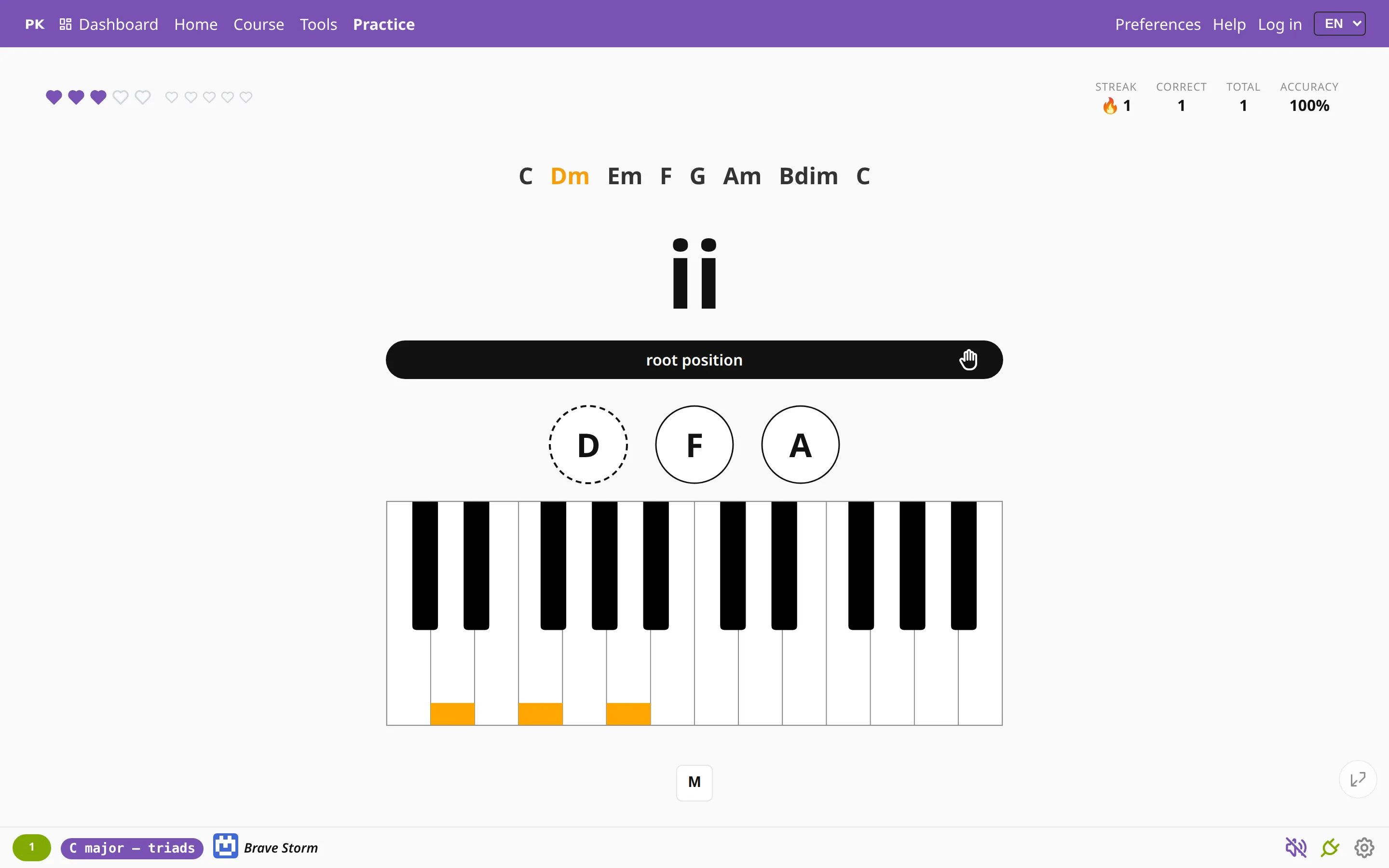
In Scales and Progressions, Question label style can name a chord by its degree.
- Roman numeral: ii, V, vi
- Roman + quality: ii V vii° (Scales only)
- Arabic numeral: 2, 5, 6
- Function: tonic, dominant
More in Chord names, numerals or functions and Chord names or sheet music.